
Forward Thinking
Welcome to Forward Thinking, where we explore the ideas, insights, and strategies shaping the future of leadership, organizational change, and culture. This is where we share what we’re learning in the field—what’s working, what’s shifting, and what leaders need to be paying attention to. Grounded in practice and informed by research, our posts are designed to help you think more critically, act more intentionally, and lead more effectively in times of change.
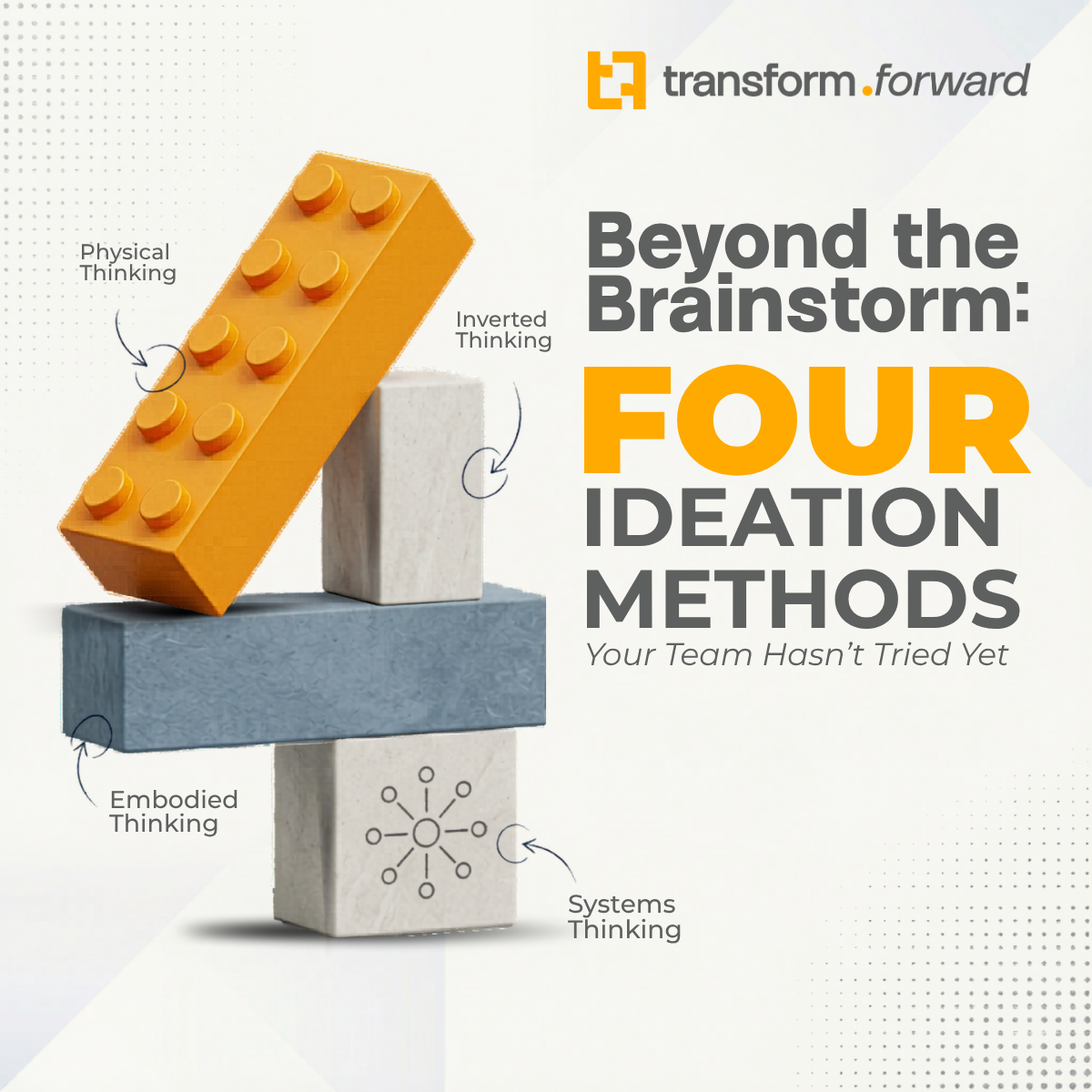
Beyond the Brainstorm: Four Ideation Methods Your Team Hasn't Tried Yet
Most teams have a default ideation format. It probably involves a whiteboard, a pack of markers, and someone who volunteered to be the scribe. It works well enough for routine problems — but for strategic planning, culture design, and decisions with long downstream consequences, "well enough" starts to show its limits.
Here are four ideation methods worth adding to your toolkit. Each one generates a distinct mode of engagement and surfaces things that a standard brainstorm doesn't — from LEGO® SERIOUS PLAY® to future wheels ideation to the surprisingly powerful pre-mortem.
The Cognitive Case for Getting Your Hands Involved
We think better when our hands are involved. The cognitive science behind that concept has been established for decades, and the practice of designing working sessions around it remains genuinely rare, even among people who care deeply about how their organizations make decisions. Giving people something physical to work with, something to sort, place, draw, or arrange, surfaces assumptions that conversation keeps invisible, encodes decisions that verbal agreement leaves fragile, and produces the kind of clarity that most planning sessions promise and rarely deliver.
Serious Business: What the Neuroscience and Organizational Research Say About Play at Work
The assumption that play is the opposite of serious work has almost no empirical support. It carries enormous cultural weight, which is part of why it persists, but the research on cognition, adult engagement, and organizational learning tells a consistently different story. When people are genuinely playing, the brain is doing something categorically different from what it does during a standard meeting. That difference has organizational consequences most leaders haven't fully accounted for.
A heads-up that this one goes deeper into the research than our typical posts. The neuroscience of play turns out to be a useful lens for understanding why certain organizational formats consistently underperform.
The LEGO® SERIOUS PLAY® Methodology and the Art of Thinking in Systems
Most strategic planning conversations aren't failing because of bad strategy. They're failing because the format of the conversation isn't built for the kind of thinking that good strategy requires. In this post, we make the case that LEGO® SERIOUS PLAY® is less a creativity tool and more a systems thinking methodology, one that helps leadership teams externalize complexity, surface hidden interdependencies, and build the shared understanding that makes a plan executable. If your planning process keeps producing the same results, the problem might not be the plan. It might be the medium.
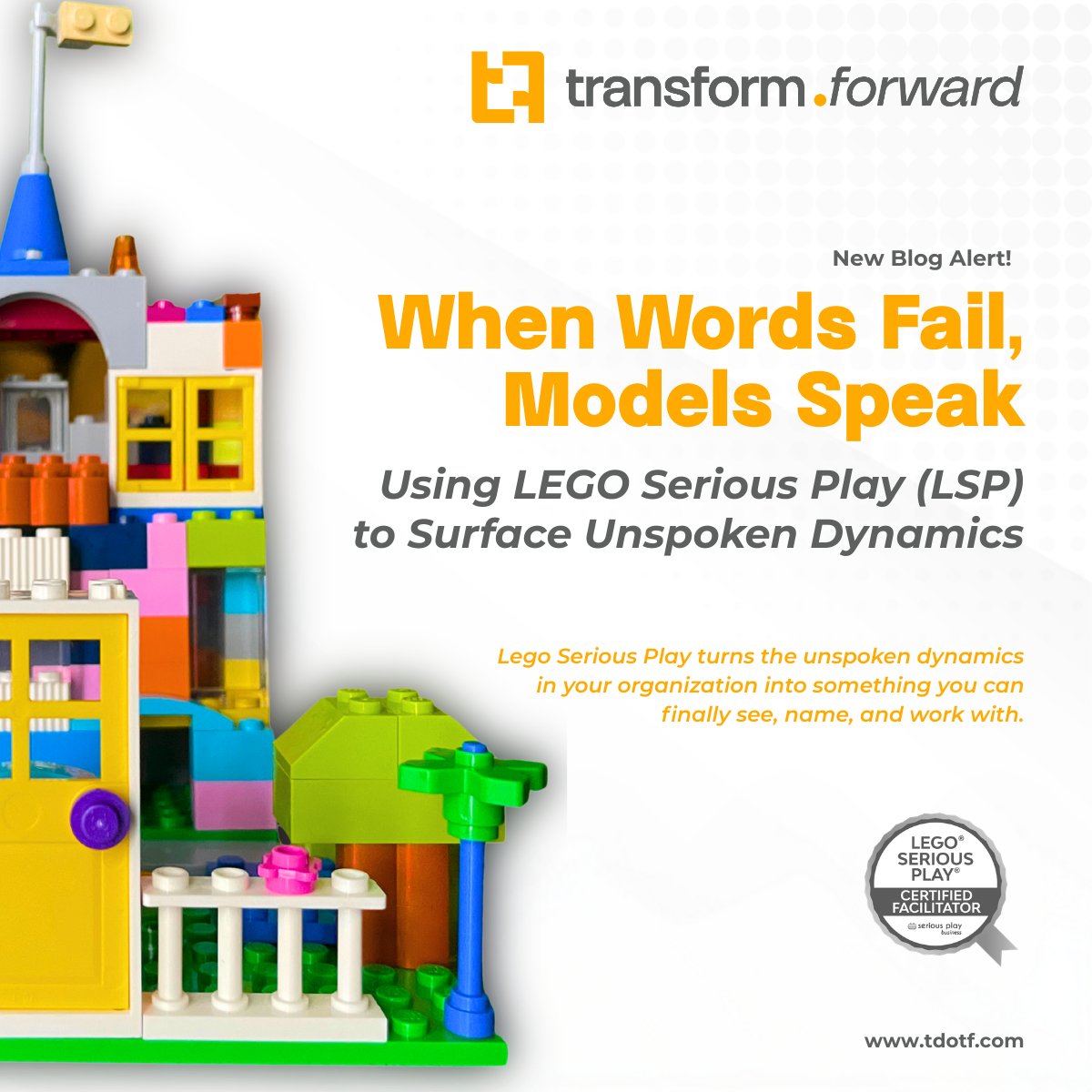
When Words Fail, Models Speak - Using LEGO Serious Play (LSP) to Surface Unspoken Dynamics
Most leadership teams leave their retreats with flip charts full of language everyone agreed to and almost no one fully believes. That is not a failure of intelligence or intention. It is a failure of medium. When organizations face genuine complexity, change, or conflict, structured verbal dialogue consistently underperforms, not because people do not have something true to say, but because the conditions of the room make it nearly impossible to say it. LEGO Serious Play (LSP) operates from a different premise. Rather than asking people to find the right words for what they know, it asks them to build it. And what gets built in those rooms is frequently the most honest organizational data available.